
Standard Deviation in Risk Management: Why Statistics are Invaluable

Table of Contents

Many reluctantly recall their statistics lectures: formulas, variance, standard deviation – and the question: What’s the point of it all? However, standard deviation holds a real treasure: it is a central tool in modern risk management.

In this edition of “Insights and Strategies from EIQF,” we show why standard deviation is more than just an abstract calculation – it is the mathematical expression of risk.

What is Risk? A Scientific Definition

In everyday life, we usually understand risk as a threat. In financial science, however, the definition is more neutral – and more precise:

Risk is the deviation from the expected value.

This means: Risk can swing both upwards (opportunity) and downwards (danger). This perspective is central to professional risk management.

Standard Deviation: The Mathematics Behind Risk

And this is precisely where standard deviation comes into play: it measures how much individual values deviate from the expected value on average – which is exactly what risk means.

The five steps to standard deviation:

  1. Calculate the deviation of each value from the mean.
    → This can be positive or negative.
  2. Square each deviation.
    → This makes all deviations positive – regardless of direction.
  3. Sum all squared deviations.
  4. Divide by the number of values (or n–1 for samples).
    → This gives the variance.
  5. Take the square root of the variance.
    → Voilà: The standard deviation!

This makes it clear: Standard deviation is the scientific definition of risk – expressed in numbers.

Download the Standard Deviation in Risk Management here

Why Standard Deviation is Indispensable in Risk Management

Especially in finance, it is crucial not only to identify risks but also to measure them quantitatively. Standard deviation allows precisely that:

  • Measure volatility
  • Assess risks in portfolios
  • Analyze scenarios
  • Compare risk-return ratios

Anyone who understands this metric masters one of the most important foundations of quantitative risk management.

More from EIQF: Blog, Videos & Podcasts

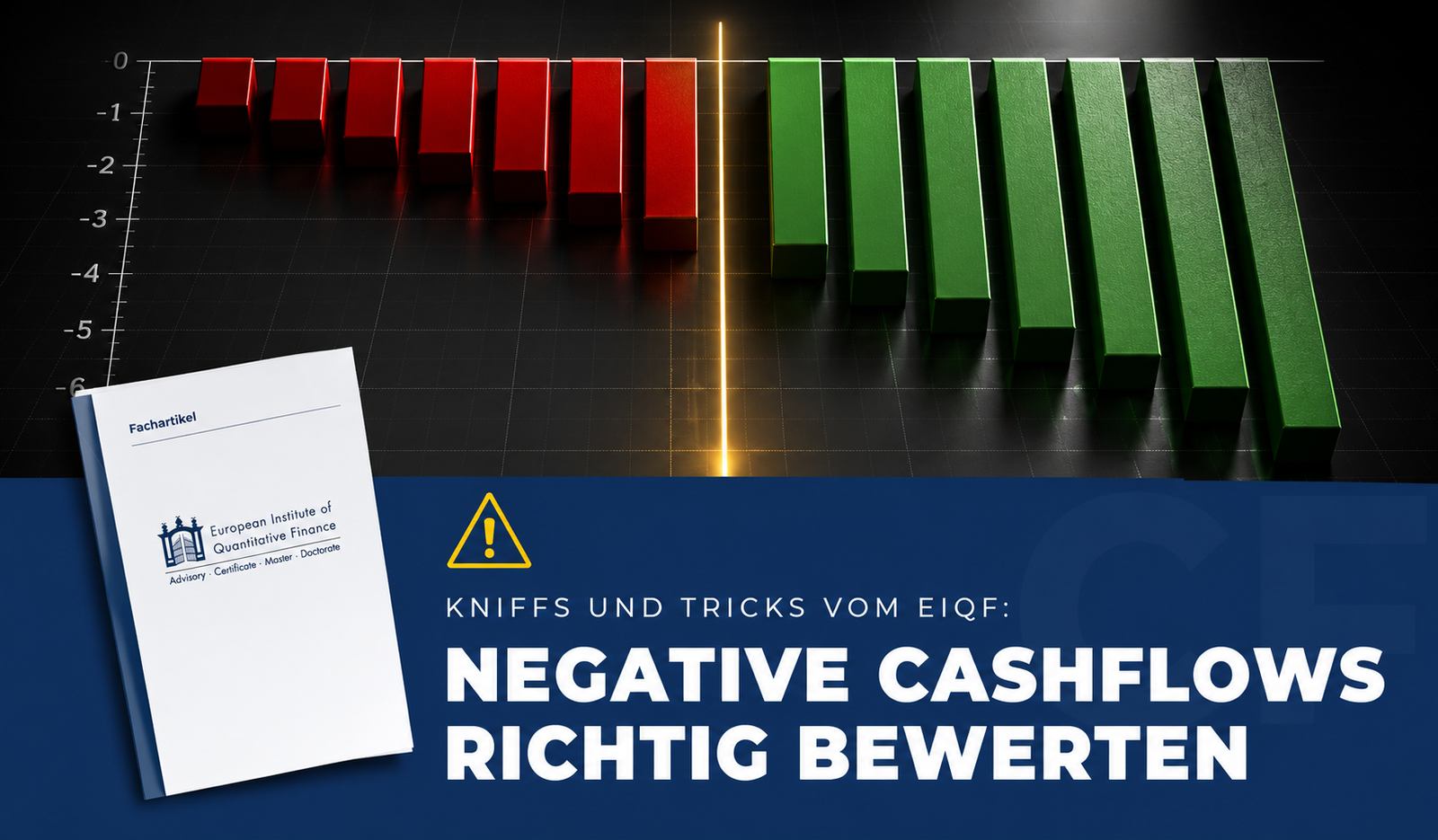
To illustrate, a simple example helps: If a payment of 10 euros occurs for the first time in year t = 1 and then annually towards infinity, the present value is 10/0.1=100 and refers to the year at t = 0. From this, we can draw the following conclusion. When we discount cash flows, the present value of these payments always refers to the point in time one period before the first cash flow occurs.

The same applies to the calculation of the Terminal Value: The TV is the present value of payments in the continuation period, which arise in years t = 6, …, ∞. The Terminal Value summarizes all future payments from year t = 6 onwards – however, its calculation refers to the valuation date t = 5, i.e., one period before the first cash flow of the continuation period.

Any questions?
You can reach us as follows

Fill out the form below.

Fill out the form below.

Fill out the form below.