
CERTIFIED FINANCIAL ENGINEER & AI (CFE)
Engineering Complex Financial Topics. Derivatives and Risk Management. Mastering Complexity with AI.
The CERTIFIED FINANCIAL ENGINEER & AI (CFE) Program
Engineering complex financial topics – mastering complexity with AI
The Certified Financial Engineer & AI (CFE) certificate provides you with practical, digital competencies to analyze and model complex financial issues and derive well-founded decisions.
The focus is on Financial Engineering, Risk Management, and Derivatives. You will learn to combine quantitative financial methods with Artificial Intelligence to make complex relationships transparent and manageable.
Using practical case studies, you will develop quantitative models, analyze risks and data, and strategically apply AI tools in modeling, analysis, and decision-making. You will also learn to critically evaluate AI-generated results and classify them from a financial perspective.
With over 10 years of experience in digital finance education, we show you how to structure and model complex financial topics, effectively use modern AI tools, and immediately apply the results in your professional practice.
- Financial Engineering & AI
- Risk Management
- Derivatives
- Data Analytics in Quantitative Finance
- Current Methods in Corporate Finance
experience
of our programs
Financial Modeling book

Free information material for the Certified Financial Engineer program
Apply today for the Certified Financial Engineer program and take the next step in your career!
Benefits of the Certified Financial Engineer Certificate
Completion in approx. 4 months – time-independent, location-independent, can be started at any time.
Personal support from experienced professors and access to a strong network.
Content is based on selected textbooks supplemented by coordinated instructional videos and numerous additional materials.
No written exams – you create models and present them professionally.
The modules cover key financial topics, including investment and financing, corporate finance, portfolio management, and derivatives, and are tailored directly to the needs of finance experts.
Step-by-step instructions and modern software.
Access to exclusive alumni and expert networks.
Officially accredited within the framework of the HfWU system accreditation.
The course can be started at any time.
Curriculum
Derivatives
- Course unit 1: How options work, value drivers of options, and the binomial model
- Course unit 2: The Black-Scholes-Merton model including the Greeks
- Course unit 3: Fundamentals and pricing of futures
- Course unit 1: Basic strategies with options and bullish option strategies
- Course unit 2: Bearish option strategies and neutral strategies
- Course unit 3: Deriving a cockpit for selecting a market-appropriate strategy
Risk Management
- Course unit 1: Calculation and presentation of risks
- Course unit 2: Risk metrics
- Course unit 3: EWMA, ARCH, and GARCH models for calculating volatility
- Course unit 1: Different types of Value at Risk and Lower Partial Moments as well as extreme value theory
- Course unit 2: Determining portfolio risks using historical simulation, Monte Carlo simulation, and copula functions
- Course unit 3: Hedging of insurable risks and modeling of non-hedged risks

JOACHIM HÄCKER

- Derivatives
- Risk Management
- Corporate Finance
1 Certificate
2 further graduation options
Certified
Financial
Modeler
Certified Financial Modeler
- Business Plan with Standards and Methods in Financial Modeling
- Company Valuation
- Mergers & Acquisition, Leveraged Buyout Private Equity and Initial Public Offering
- Portfolio Management
MBA
Applied
Quantitative
Finance
MBA
Applied
Quantitative
Finance
LEARN MORE
Certified
Financial
Engineer
Certified Financial Engineer
Financial Engineering
- Data Analytics in Quantitative Finance
- Venture Capital and Innovation Finance
- Risk Management
- Current Methods in Corporate Finance
- Derivatives
Information Options
An initial overview of the content, structure, and organization of the Certified Financial Modeler program:
In the info video, the professors concisely present the main features of the Certified Financial Modeler program.
Information on Admission, Registration & Participation Fees
The participation fees for the Certified Financial Engineer & AI (CFE) are structured as follows:
- Course fees: €3,357.14 plus 19% VAT, totaling €3,995.00.
- Scholarship: An EIQF scholarship can be applied for. This reduces the course fees to: €1,256.30 plus 19% VAT, totaling €1,495.00.
- For students: €995.00 incl. 19% VAT (net amount €836.13, included VAT €158.87).
The course fees include examination fees, the course book as an e-book, and access to extensive learning materials. No further costs are incurred.
Basic knowledge of finance and Excel.
Willingness to participate in an intensive, practice-oriented program.
Registration possible at any time

The financial world is undergoing fundamental change. Artificial Intelligence, Data Analytics, and digitalization are transforming processes, analyses, and decisions in companies, banks, insurance firms, and consulting.
There is demand for employees who understand finance, master quantitative methods, and can strategically apply modern AI tools. Crucially, this involves the ability to analyze data, develop models, critically evaluate AI results, and translate these into well-founded financial decisions.
Finance professionals who want to improve their career opportunities through in-depth knowledge of financial modeling.
Advisors and consultants who want to strengthen their analytical skills and offer their clients sound financial models and analyses.
Bank employees and financial service providers who want to expand their competence in creating and analyzing complex financial models to open up better professional opportunities.
IT and data science experts who want to specialize in financial models and apply their technical skills in the field of financial modeling.
Professionals who want to expand and optimize their consulting services through specialized skills in financial modeling.
Managers and executives who want to make sound financial decisions based on precise models and thereby improve their strategic skills.

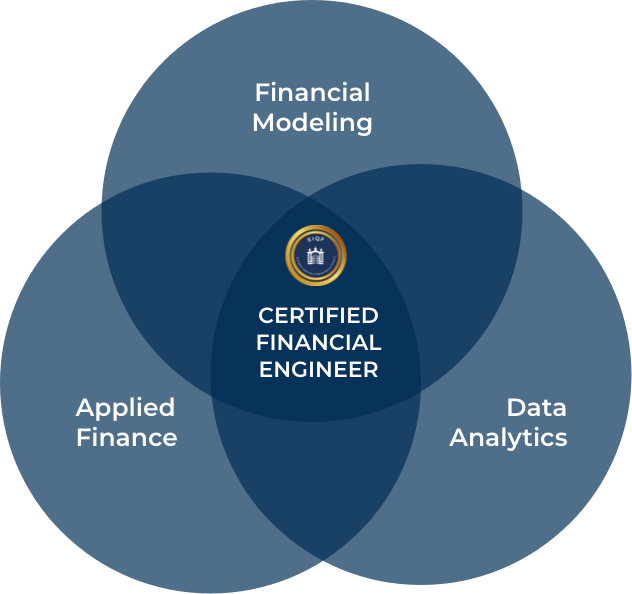
With 10 modules, one might expect them to be taught by 10 different professors. However, behind the 10 modules are exactly 2 professors who have created this teaching content over the last 20 years in the form of consecutive publications. Using interconnected modules, you will learn how the individual elements of financial modeling, financial engineering, and data analytics are related.
What other quants say about the program
The Certified Financial Engineering program is one of the best learning experiences
I have ever had. It is a well-designed course with a strong
practical focus. I am very satisfied with the training offered by the European Institute of Quantitative Finance
. The training is based entirely
on industry projects and practical solutions to real problems. The
instructors are competent, have very strong industry knowledge, and
can identify students’ needs. The guidance provided
by the instructors was excellent, and the overall experience is
very good. If you want to optimize your technical skills, I personally
recommend participating in EIQF.
The Certified Financial Engineer program offered by the European Institute of
Quantitative Finance (EIQF) was very useful in my case as it
is well-structured and takes into account the latest developments in the field.
It is largely among the best in the world and represents an
excellent opportunity for theoretical and practical improvement for all participants.

The Certified Financial Engineer emphasizes the importance of knowledge within the financial world. The worldwide regulatory body cannot replace continuous education. It is the depth of the Certified Financial Engineer program that portrays a new picture to participants and sets a whole new standard for the financial community.

The Certified Financial Engineer program from the European Institute of Quantitative Finance is a practice-oriented qualification in the field of derivatives.
In terms of content, it covers valuation methods for options and futures (binomial model, Black-Scholes-Merton model) as well as different strategies (bullish, bearish, and neutral strategies). Thanks to a comprehensive course book, the content is easy to understand even without prior knowledge.
If you get stuck, the professors provide helpful support.
You are very flexible in terms of time, which means the course can also be completed alongside your job.
The course can be credited toward the MBA program.
This course is highly recommended for anyone who would like to further their education in derivatives.
I really enjoyed the Certified Financial Engineer program due to its practical application in Excel and the excellent transfer of knowledge it enabled. I was finally able to learn how to work effectively with derivatives expertise and create added value—whether for my clients or in my own trading in the markets. This was an excellent technical and practical complement to the Certified Financial Modeler. The teaching materials were of outstanding quality, offering valuable content both for those who prefer videos and for those who prefer the classic textbook. The implementation examples are true treasures for one’s personal repertoire, allowing you to refer back to them as a reference in the future. I also appreciated the deep financial-mathematical theory, which sharpens fundamental understanding. The investment in this program will certainly yield a high return!
I really enjoyed the Certified Financial Engineer program due to its practical application in Excel and the excellent transfer of knowledge it enabled. I was finally able to learn how to work effectively with derivatives expertise and create added value—whether for my clients or in my own trading in the markets. This was an excellent technical and practical complement to the Certified Financial Modeler. The teaching materials were of outstanding quality, offering valuable content both for those who prefer videos and for those who prefer the classic textbook. The implementation examples are true treasures for one’s personal repertoire, allowing you to refer back to them as a reference in the future. I also appreciated the deep financial-mathematical theory, which sharpens fundamental understanding. The investment in this program will certainly yield a high return!
The Certified Financial Engineer program is ideally suited to improving your knowledge of derivative financial instruments. The sometimes complex financial-mathematical background is presented very clearly. I would particularly like to highlight the first-class support from the professors. You quickly notice that a great deal of effort and dedication has gone into the program.
The Certified Financial Engineer program provides comprehensive knowledge in the field of derivatives and thus makes a significant contribution to financial education in Germany. The accompanying teaching material guides you through the complex financial-mathematical subject matter in an understandable and clear way, making problem-solving enjoyable. The program is particularly recommended for young professionals, as its flexible design allows it to be completed alongside a job. The knowledge gained can therefore be applied not only directly in everyday professional life, but also in building private wealth.
FAQ - Certified Financial Engineer
What is the Certified Financial Engineer (CFE)?
Which specializations can be chosen?
Who is the program suitable for?
How is the course structured?
How does the application process work?
Apply today for the Certified Financial Engineer program and take the next step in your career!