
TIPS AND TRICKS FROM EIQF: BESSEL’S CORRECTION
Youtube Linkedin Envelope Table of Contents Have you ever wondered why, when calculating the standard deviation, we sometimes divide by 𝓷 and sometimes by 𝒏-1?
In an increasingly volatile economic environment, systematic portfolio management is gaining more importance than ever. The success of wealth accumulation and preservation today largely depends on how sound and adaptable investment strategies are designed. The second edition of the textbook “Portfolio Management” addresses these requirements and provides an up-to-date, comprehensive, and practical introduction to modern asset management.
The new edition was primarily authored by Prof. Dr. Leander Geisinger, Marc Schurer, and Prof. Dr. Dr. Ernst. It is one of the few German-language textbooks that systematically presents both active and passive portfolio management. Readers are offered a complete learning path – from quantitative fundamentals and theoretical models to practical application with Excel and MATLAB.
A key advantage: no special prior knowledge is required. The book is aimed at both students and professionals who wish to develop a deep yet accessible understanding of portfolio management.
The textbook stands out due to its lively presentation. It is not limited to theoretical concepts and formulas but conveys content through stories, portraits, and quotes from significant financial scholars. This makes it clear: behind every theory are people, ideas, and historical developments – an approach that sustainably supports learning.
The text is supplemented by numerous graphics that visualize complex content.
At the end of each chapter, you will find summaries, test questions for knowledge review, and bibliographies that facilitate access to original literature.
Particularly practical: All Excel files and MATLAB codes used are available for free download via the UTB homepage – a real plus for studies and professional development.
The book is used in various academic contexts – for example, in the Bachelor’s program International Financial Management, the Master’s program International Finance, and the part-time MBA Applied Quantitative Finance. Beyond the lecture hall, it also offers finance professionals and career changers a reliable guide for developing and implementing modern investment strategies.
With its in-depth content, methodical clarity, and didactic quality, the second edition of Portfolio Management sets new standards in German-language financial literature. It offers not only a sound introduction to the world of capital markets but also a solid foundation for the practical implementation of investment strategies.
Available via UTB and common book platforms.
Active portfolio management aims to outperform the market through targeted buying and selling decisions. Passive portfolio management, on the other hand, relies on long-term investment strategies, usually via index funds or ETFs, and aims to replicate market performance.
Key methods include risk and return analyses, diversification techniques, and optimization procedures such as mean-variance optimization. The book explains these fundamentals in a practical way and shows how they can be applied with Excel and MATLAB.
No, the textbook is designed so that no special prior knowledge is necessary. It is aimed at both beginners and experienced financial professionals who wish to refresh or deepen their knowledge.
In addition to theoretical explanations, the book contains numerous graphics, examples, and exercises. All Excel and MATLAB files used are also available for download online to facilitate the implementation of the models.
The book is aimed at students in finance degree programs, participants in MBA programs, and professionals in banking, asset management, or financial advisory who wish to systematically expand their understanding of portfolio management.

Youtube Linkedin Envelope Table of Contents Have you ever wondered why, when calculating the standard deviation, we sometimes divide by 𝓷 and sometimes by 𝒏-1?

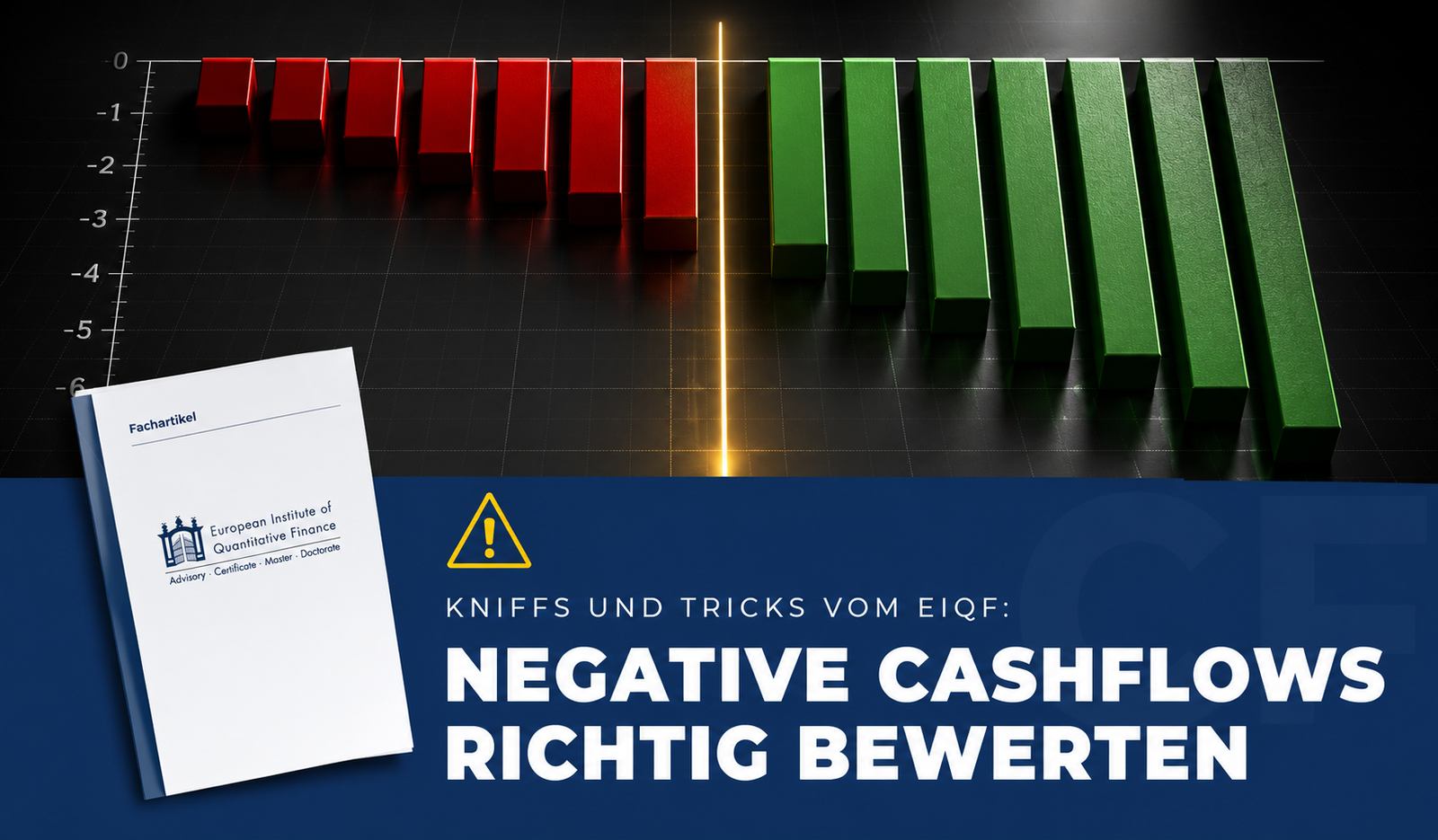
Youtube Linkedin Envelope Table of Contents In corporate planning practice, the cash flow statement has often been neglected to date, even though it represents a

Youtube Linkedin Envelope Table of Contents In an increasingly volatile and crisis-prone world, traditional deterministic management planning is reaching its limits. Target-value-oriented planning systematically ignores

Youtube Linkedin Envelope Table of Contents Exactly 100 years ago, in 1925, Werner Heisenberg published his groundbreaking article: 👉 “On the Quantum-Theoretical Reinterpretation of Kinematic

The semi-standard deviation (also downside deviation) measures the dispersion below a reference value (usually the mean or a target return such as 0%).

Many reluctantly recall their statistics lectures: formulas, variance, standard deviation – and the question: What’s the point of it all? However, standard deviation holds a real treasure: it is a central tool in modern risk management.