TIPS AND TRICKS FROM EIQF: BESSEL’S CORRECTION
Youtube Linkedin Envelope Table of Contents Have you ever wondered why, when calculating the standard deviation, we sometimes divide by 𝓷 and sometimes by 𝒏-1?

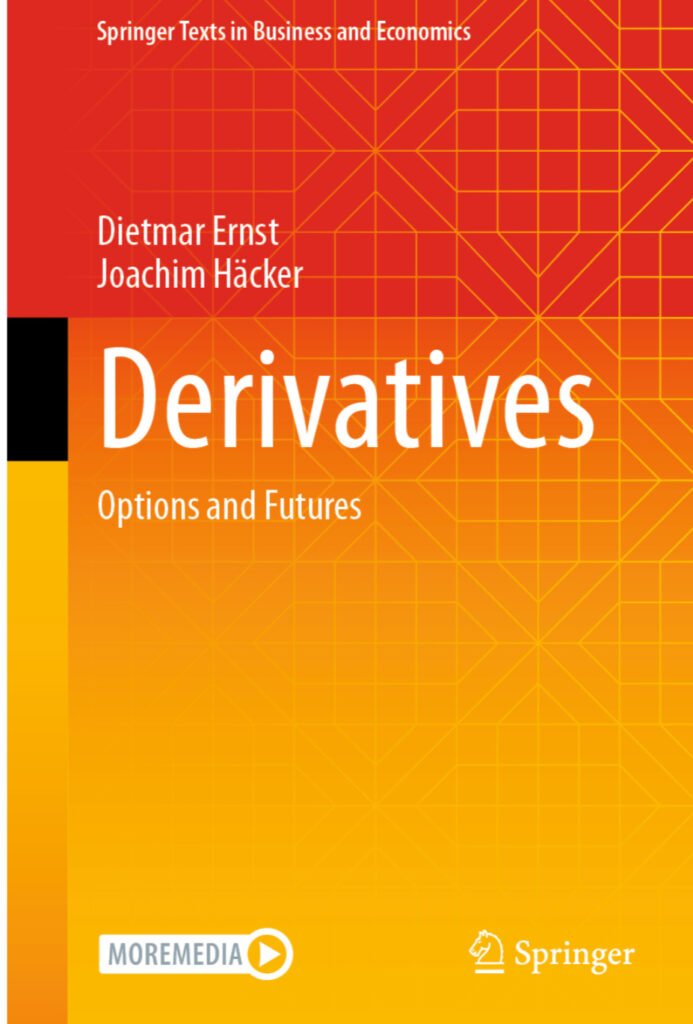
Derivatives are considered one of the most complex topics in the world of finance – but that does not have to be the case. Our new book “Derivatives, published in English by Springer, shows: Anyone can understand, model and apply derivatives – entirely without prior knowledge.
Many students and practitioners have reservations about derivatives. Our goal: Break down barriers and promote understanding. In our book, we guide you systematically and clearly through the topic. With the help of a realistic case study we explain step by step how the most important formulas are put together – and how you can you this model it yourself in Excel .
A highlight of the book: Implementing all concepts in Microsoft Excel. Using clear instructions, you can build the models yourself and thus transfer theoretical knowledge directly into practical application . This strengthens understanding and shows that derivatives do not have to be a black box.
For every exercise in the book, there are high-quality learning videos, that guide you through the content. Ideal for self-study, but also perfect for use in lectures or seminars. include seminars. This allows you to learn derivatives online – visually, interactively and clearly.
The book is already being used successfully in the MBA Applied Quantitative Finance at the Nürtingen-Geislingen University of Economics and Environment (HfWU) used. The didactically sound presentation is effective: students regularly report of rapid learning progress and aha moments.
Those who prefer to read in German will also find what they are looking for: The German version of the book has been published by the renowned UTB publishing house – with an identical didactic structure and all Excel and video content.
Those who would like to engage with derivatives in greater depth can deepen their knowledge in our professional development programmes. Certified Financial Engineer (CFE) with a focus on derivatives or the MBA Applied Quantitative Finance.
We would like to extend our sincere thanks to Prof. Dr. Dr. Joachim Häcker, co-author and derivatives expert at the European Institute of Quantitative Finance. He has played a key role in shaping the content of the book and the teaching videos – rigorous, practice-oriented and didactically well thought out.
Whether students, practitioners or career changers – our new book makes getting started in the world of derivatives easy. Derivatives entirely easy. Clearly explained, visually supported and modelled with practical relevance . Join us on the derivatives adventure – it is worth it!
Derivatives are financial instruments whose value is derived from an underlying asset ( e.g. shares, interest rates, commodities) . They are used among other things for hedging or speculation. Examples include options, futures and swaps. options, futures directly swaps.
Yes! Our book “Derivatives” explains the fundamentals step by step and without prior knowledge. With clear examples and Excel models, we make getting started easy – ideal for students, early-career professionals and practitioners. practitioners.
By modelling the formulas in Excel readers intuitively :understand the mathematical relationships. This makes abstract theory tangible and directly applicable – a proven learning approach from our teaching. teaching
Yes, the book contains numerous practical exercises, which can be solved in Excel. All exercises are explained clearly in accompanying videos – ideal for self-study or for teaching.
The book is aimed at students, finance practitioners, career changers and lecturers, who want to understand derivatives and apply them in practice – without mathematical overload.

Youtube Linkedin Envelope Table of Contents Have you ever wondered why, when calculating the standard deviation, we sometimes divide by 𝓷 and sometimes by 𝒏-1?

Youtube Linkedin Envelope Table of Contents In corporate planning practice, the cash flow statement has often been neglected to date, even though it represents a

Youtube Linkedin Envelope Table of Contents In an increasingly volatile and crisis-prone world, traditional deterministic management planning is reaching its limits. Target-value-oriented planning systematically ignores
Youtube Linkedin Envelope Table of Contents Exactly 100 years ago, in 1925, Werner Heisenberg published his groundbreaking article: 👉 “On the Quantum-Theoretical Reinterpretation of Kinematic

The semi-standard deviation (also downside deviation) measures the dispersion below a reference value (usually the mean or a target return such as 0%).


Many reluctantly recall their statistics lectures: formulas, variance, standard deviation – and the question: What’s the point of it all? However, standard deviation holds a real treasure: it is a central tool in modern risk management.