
CORRECTLY VALUING NEGATIVE CASH FLOWS – A COMMON MISTAKE IN PRACTICE

Negative Cashflows richtig bewreten

Table of Contents

In the MBA Applied Quantitative Finance program at Nürtingen-Geislingen University (HfWU), we discuss current topics in corporate valuation. A student asked how negative cash flows should be discounted. I am pleased to summarize the results of our discussion for you.

In corporate valuation and capital budgeting, the risk-adjusted discount rate method is frequently used: uncertain cash flows are discounted using a risk-adjusted discount rate. This works well – as long as the cash flows are positive.

It becomes problematic with negative cash flows.

MATHEMATICAL PROBLEM

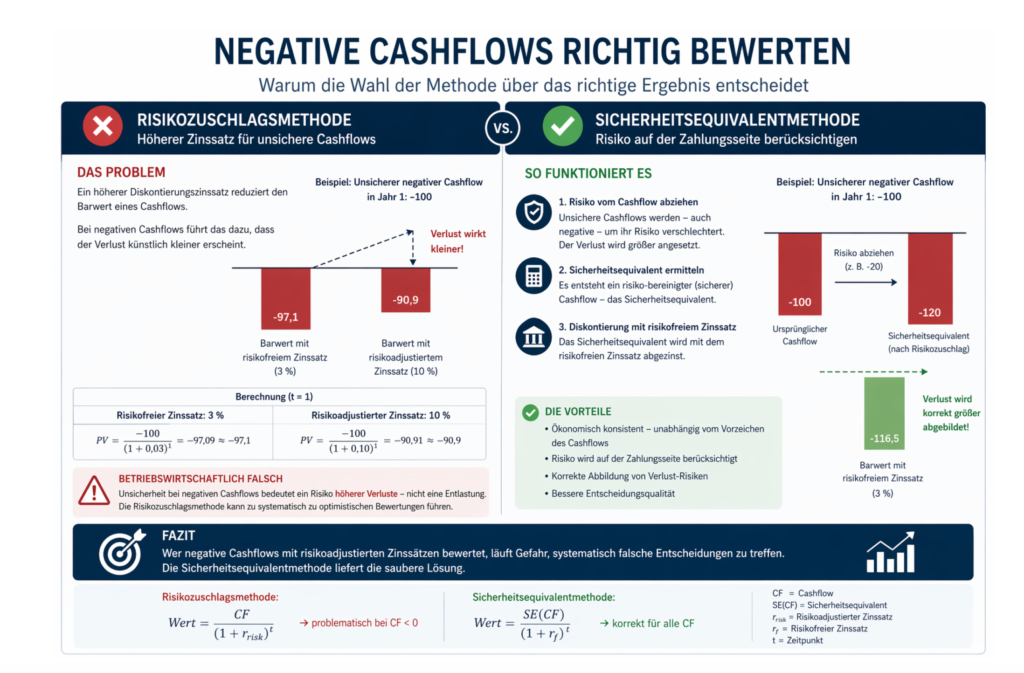
A higher discount rate reduces the present value of a cash flow. For positive cash flows, this is intuitively correct: more risk → lower value.

With negative cash flows, however, the opposite occurs:
A higher rate “reduces” the negative present value. Formally, this means that an uncertain negative cash flow carries less weight than a certain negative cash flow.

This is mathematically consistent – but economically questionable.

ECONOMIC MISINTERPRETATION

Risk does not only mean “chance of better outcomes,” but also “danger of higher losses.” An uncertain negative cash flow is therefore often more critical from a decision-making perspective than a certain one.

The risk-adjusted discount rate method, however, implicitly treats this risk as a relief – and can thereby lead to systematically biased valuations.

THE SOLUTION: Certainty Equivalent Method

Instead of changing the discount rate, the cash flow itself is adjusted:

Negative Cashflows

THE CENTRAL PRINCIPLE

Risk is accounted for on the cash flow side – not in the discount rate.

ADVANTAGE OF THIS METHOD

It remains economically consistent – regardless of the sign of the cash flow. Negative risks are not “discounted away,” but correctly reflected.

CONCLUSION

Those who value negative cash flows with risk-adjusted discount rates run the risk of making systematically incorrect decisions. The certainty equivalent method provides the rigorous solution here.
Any questions?
You can reach us as follows

Fill out the form below.

Fill out the form below.

Fill out the form below.